

Hairline Lowering with FUE: A Natural Solution for a High Forehead
A naturally high hairline can make the forehead appear taller and change the way the face is framed, even when there is no active hair loss.
For selected patients, hairline lowering with FUE can reduce the visible height of the forehead by placing suitable donor follicles below the existing hairline. As these follicles grow, they create a lower frontal frame without physically moving the scalp.
The aim is not simply to place the hairline as low as possible. The new position must suit the patient’s facial proportions, available donor supply, temple shape and long-term risk of hair loss.
At Bijan Clinic in Auburn, Sydney, every treatment plan begins with an individual assessment of the current hairline, donor area and the amount of lowering that can be supported responsibly.
This guide explains:
- How FUE hairline lowering works
- Who may be suitable
- How far a hairline may be lowered
- Why forehead width affects graft requirements
- How FUE compares with surgical forehead reduction
- What recovery, cost and results may involve
Hairline lowering is one specific form of hair transplantation. For broader information about frontal recession, graft planning and long-term restoration, read our complete hairline transplant guide.
Book your free hairline assessment →
Hairline Lowering FUE at a Glance
| Treatment detail | General information |
|---|---|
| Primary purpose | Reduce the appearance of a naturally high forehead or elevated hairline |
| Technique | FUE hair transplantation |
| Donor area | Usually the back or sides of the scalp |
| Anaesthesia | Local anaesthesia |
| Result development | Gradual, as transplanted follicles begin growing |
| Initial growth | Often begins around months 3–4 |
| Maturation | May continue over approximately 12–18 months |
| Starting price | From $7,000 AUD |
| Clinic location | Auburn, Sydney |
| Consultation | In-clinic or video assessment |
Suitability, graft requirements, recovery and results vary between patients.
What Is Hairline Lowering with FUE?
Hairline lowering with FUE is a hair-transplant procedure that creates a new frontal hairline below the patient’s existing line.
Individual follicular units are removed from a suitable donor area and implanted into the skin across the upper forehead. Once the transplanted follicles begin producing hair, the forehead appears shorter and the new hairline becomes part of the facial frame.
The treatment may also be described as:
- Hairline lowering transplant
- High forehead hair transplant
- FUE hairline lowering
- Lower hairline transplant
- Forehead reduction hair transplant
Unlike surgical forehead reduction, FUE does not advance the scalp or remove a strip of forehead skin. It lowers the visible hairline by adding growing follicles below the original boundary.
FUE avoids a single linear donor scar, but it is not scar-free. Small circular extraction sites are created wherever follicular units are removed. Their visibility varies according to the extraction pattern, healing, skin characteristics and hairstyle.
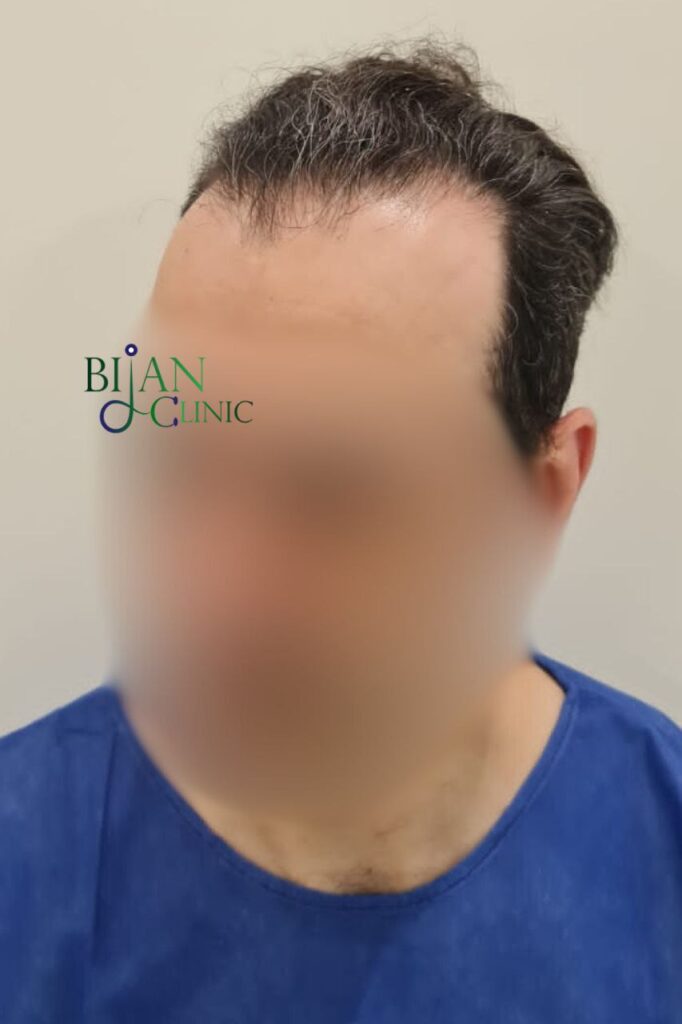
Can FUE Lower a Naturally High Hairline?
Yes, selected patients with adequate donor hair may be able to lower a naturally high hairline using FUE.
The procedure is most relevant when the patient’s main concern is the position of the frontal hairline rather than widespread thinning across the scalp.
Potential concerns that may be addressed include:
- A naturally high forehead
- A hairline that has remained high since adolescence
- Mild frontal recession
- Deeper temporal corners
- An uneven frontal line
- Localised asymmetry
- Selected stable scars near the hairline
- A previous hairline that was positioned too high
A consultation is needed because a high-looking forehead is not always the same as a stable, naturally high hairline. In some patients, the visible change may be caused by continuing recession.
Is the Hairline Naturally High or Receding?
This distinction is central to treatment planning.
A person with a naturally high hairline may have had a similar forehead shape for many years, without obvious progressive thinning. Another patient may previously have had a lower hairline that has gradually moved backwards because of pattern hair loss.
Assessment may consider:
- Earlier photographs
- Recent changes in forehead height
- Recession at the temporal corners
- Miniaturisation behind the frontal line
- Family history of hair loss
- Current age
- Hair density behind the hairline
- Donor-area stability
- Diffuse thinning
When recession is still progressing, lowering the line too aggressively may create a transplanted front with thinning native hair behind it.
The proposed position therefore needs to account for how the surrounding hair may change over time—not just how the forehead looks at the consultation.
How Far Can a Hairline Be Lowered with FUE?
There is no universal measurement that is suitable for every patient.
The amount of lowering depends on:
- Forehead width and height
- Existing hairline position
- Temple shape
- Donor density
- Hair calibre and texture
- Desired coverage
- Existing hair loss
- Future recession risk
- The number of grafts that can be harvested responsibly
Even a modest vertical change can create a relatively large recipient area because the new zone extends across the width of the forehead.
For example, lowering the centre of the hairline is not just about filling one narrow strip. The new line must usually connect across the frontal width and transition naturally toward the temporal corners.
This is why the appropriate question is not simply:
How many centimetres can my hairline be lowered?
It is:
What position can be supported naturally by my facial proportions and available donor supply?
Why Forehead Width Affects Graft Requirements
The number of grafts required does not depend only on how far the hairline moves vertically.
A wider forehead creates a larger treatment area. Temple involvement can expand that area further.
Graft requirements may be influenced by:
- The width of the proposed frontal zone
- The depth of lowering
- Whether the temporal corners are included
- Hair calibre
- Hair curl or wave
- Colour contrast between the scalp and hair
- Desired density
- Existing hairs within the new zone
- Availability of finer grafts for the leading edge
A lower line created with insufficient coverage may appear thin or visually abrupt. In some patients, a slightly more conservative position allows stronger coverage and a more sustainable use of the donor area.
The donor region is a limited resource, and progressive hair loss may create a need to preserve follicles for future restoration.
How the New Hairline Position Is Planned
Planning a lower hairline involves more than measuring the distance between the eyebrows and the scalp.
The proposed position may be assessed in relation to:
Forehead proportions
The doctor considers the visible height and width of the forehead, rather than relying on a single fixed ratio.
Two patients requesting the same amount of lowering may need very different designs because their forehead width, brow position and facial shape differ.
The central hairline point
The central point helps establish the apparent forehead height, but it must connect naturally with the rest of the frontal line.
Lowering only the centre without planning the surrounding curvature may create an unnatural or isolated appearance.
Temporal corners
The temporal corners influence how wide or narrow the forehead appears.
They should not automatically be filled completely. In some patients, retaining a degree of temporal recession produces a more balanced and sustainable result.
Donor limitations
The design must be supported by the number and quality of follicles that can be removed safely.
A requested position may need to be adjusted when it would consume an excessive proportion of the available donor supply.
Future hair loss
A new line should remain visually connected to the surrounding hair if native hair loss continues.
This is especially important for younger patients and people showing signs of progressive frontal recession.
Detailed principles such as graft angle, controlled irregularity and transition-zone planning are covered in our guide to natural hairline design.
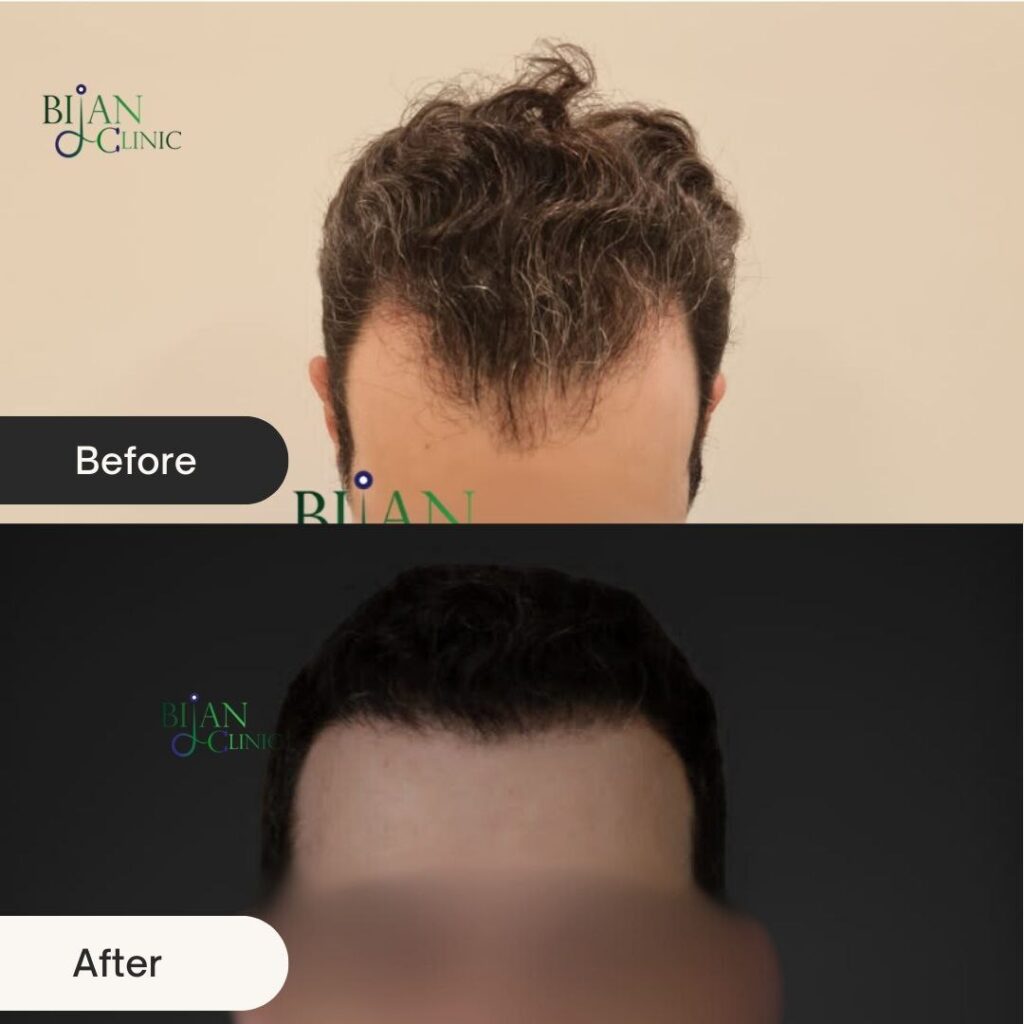
A Real Hairline Lowering Case at Bijan Clinic
Patient concern
The patient wanted to improve the appearance of a high and recessed frontal hairline and create better facial framing.
What was assessed
Dr Bijan assessed the existing hairline shape, frontal proportions, temporal corners, hair characteristics and the overall suitability of the proposed lowering design.
Why this position was selected
The new hairline position was designed by Dr Bijan at Bijan Clinic to create a more balanced frontal frame while maintaining a natural shape that suited the patient’s existing hairline and facial proportions.
Graft-placement strategy
The frontal edge was designed to appear soft and natural, with the transplanted hairs positioned to follow the direction of the surrounding native hair.
Confirmed case details
Technique: FUE
Hairline design: Designed by Dr Bijan at Bijan Clinic
Image timing: Before treatment and follow-up result
Current status: Follow-up result shown in the available clinical images
How FUE Is Used for Hairline Lowering
Hairline lowering uses the same broad follicular transplantation principles as other FUE procedures. The key difference is that grafts are used to create a new hair-bearing zone below the existing line.
Assessment and marking
The donor area and frontal zone are assessed, and the proposed line is drawn directly on the scalp.
The position is reviewed before the recipient sites are created.
Local anaesthesia
The donor and recipient areas are numbed using local anaesthesia. Brief discomfort may occur during the injections, while most patients experience limited discomfort once the areas are numb.
Follicular-unit extraction
Individual follicular units are removed from the donor region using small punches.
The extraction pattern should avoid concentrating too many removals in one area, as excessive harvesting may leave visible thinning and reduce future options.
Graft selection and placement
Finer follicular units are generally preferred near the front edge, while units containing more hairs may be positioned behind them to improve visual coverage.
The placement plan needs to account for:
- Direction of natural growth
- Angle of exit from the scalp
- Spacing between grafts
- Density transition
- Connection with the original hairline
- Temporal-corner shape
Graft selection, recipient-site placement and the patient’s individual characteristics all affect how natural the transplanted area appears.
For a detailed explanation of extraction and implantation, read about FUE hair transplant in Sydney.
Hairline Lowering FUE vs Surgical Forehead Reduction
Hairline lowering with FUE and surgical forehead reduction can both reduce the appearance of a tall forehead, but they use fundamentally different approaches.
| Hairline lowering with FUE | Surgical forehead reduction |
|---|---|
| Follicles are transplanted below the existing hairline | The hair-bearing scalp is surgically advanced |
| The result appears gradually as new hair grows | The hairline position changes immediately |
| Requires suitable donor follicles | Requires appropriate scalp mobility |
| Creates individual FUE extraction sites | Creates an incision along the frontal hairline |
| Can address selected temple recession and asymmetry | Primarily shortens the visible forehead |
| Density depends on graft supply and growth | Existing hair-bearing scalp is repositioned |
| Further density may sometimes be considered later | Revision needs depend on healing, scar outcome and anatomy |
Neither method is automatically better for every patient.
FUE may be considered when the patient:
- Has adequate donor hair
- Prefers follicular restoration
- Wants detailed control over the new shape
- Has temporal recession or asymmetry
- Accepts that the result develops gradually
Surgical forehead reduction may be considered by an appropriately qualified surgeon when the patient has suitable scalp anatomy and wants a more immediate positional change.
A balanced consultation should explain the strengths and limitations of both approaches rather than presenting either method as universally superior.
Hairline Lowering FUE Cost in Sydney
Hair-transplant packages at Bijan Clinic currently start from $7,000 AUD. The final quote depends on the patient’s treatment plan. The clinic’s current pricing page states that its hair-transplant packages include PRP therapy and follow-up care.
Factors affecting the cost of hairline lowering may include:
- Amount of lowering requested
- Width of the new frontal zone
- Temple involvement
- Estimated graft requirement
- Donor density
- Hair calibre and texture
- Complexity of the proposed shape
- Previous surgery or scarring
- Need for corrective work
During consultation, the patient should receive:
- A proposed hairline position
- An individual graft estimate
- A clear quote
- An explanation of package inclusions
- Information about available payment options
The previous page copy referring to a different price range should be removed so that pricing remains consistent across the site.
View current hair transplant pricing →
Frequently Asked Questions About Hairline Lowering FUE
Can FUE lower a naturally high forehead?
In selected patients, donor follicles can be implanted below the existing hairline to reduce the visible height of the forehead. Suitability depends on donor supply, facial proportions and scalp condition.
How far can the hairline be lowered?
There is no standard distance. The appropriate position depends on forehead width, donor density, hair characteristics, temple involvement and long-term planning.
Is hairline lowering the same as a standard hair transplant?
It uses the same general FUE principles, but the treatment objective is different. Hairline lowering creates a new frontal zone below the existing line, while other procedures may mainly restore recession or add density within an existing hairline.
How many grafts are needed?
The number depends on the width of the forehead, amount of lowering, temple involvement, hair calibre, desired coverage and donor supply. A personalised assessment is needed for a meaningful estimate.
Does FUE hairline lowering leave scars?
FUE avoids a single linear donor scar but creates small individual extraction marks. Their visibility varies between patients.
Will the transplanted hair grow permanently?
Follicles selected from a stable donor area are generally more resistant to pattern hair loss and may continue growing long term. However, no procedure can guarantee the survival of every graft, and native hair may continue to thin.
Can the new hairline look too low?
Yes. A line positioned too low may consume unnecessary donor grafts, provide weaker density and become less appropriate if the surrounding native hair recedes.
Is FUE better than surgical forehead reduction?
Neither option is universally better. FUE creates a lower hairline through follicular transplantation, while forehead-reduction surgery physically advances the scalp. Suitability depends on anatomy, donor hair, goals and preferences.
When does the transplanted hair begin growing?
Early growth may begin around three to four months. Density and texture generally continue developing over the following months.
Can one procedure provide enough density?
Some patients may achieve suitable coverage after one session. Others may consider further density only after the initial result has matured and the donor area has been reassessed. ISHRS guidance notes that achieving the desired central density in hairline-lowering cases may sometimes require a later touch-up.
Can a high hairline be lowered without surgery?
Hairstyling and cosmetic camouflage may alter the visible appearance temporarily, but FUE hair transplantation and surgical forehead reduction are surgical approaches. A consultation is needed to discuss suitable options.
Book a Hairline Lowering Assessment in Sydney
The first step is not choosing a fixed number of centimetres or copying another person’s hairline.
It is determining:
- Whether the hairline is naturally high or actively receding
- How much donor hair is available
- What position suits the face
- How large the new recipient area would be
- Whether the temporal corners should be treated
- How the design may age over time
- Whether FUE is the most suitable option
Book a consultation with Bijan Clinic to discuss your current hairline, donor supply and realistic treatment options.
Individual results vary. Suitability, graft requirements, lowering distance, recovery and outcomes depend on clinical assessment. This page provides general educational information and does not replace personalised medical advice.


