
Can a Hair Transplant Cover a Scar After Eyebrow Lift Surgery?
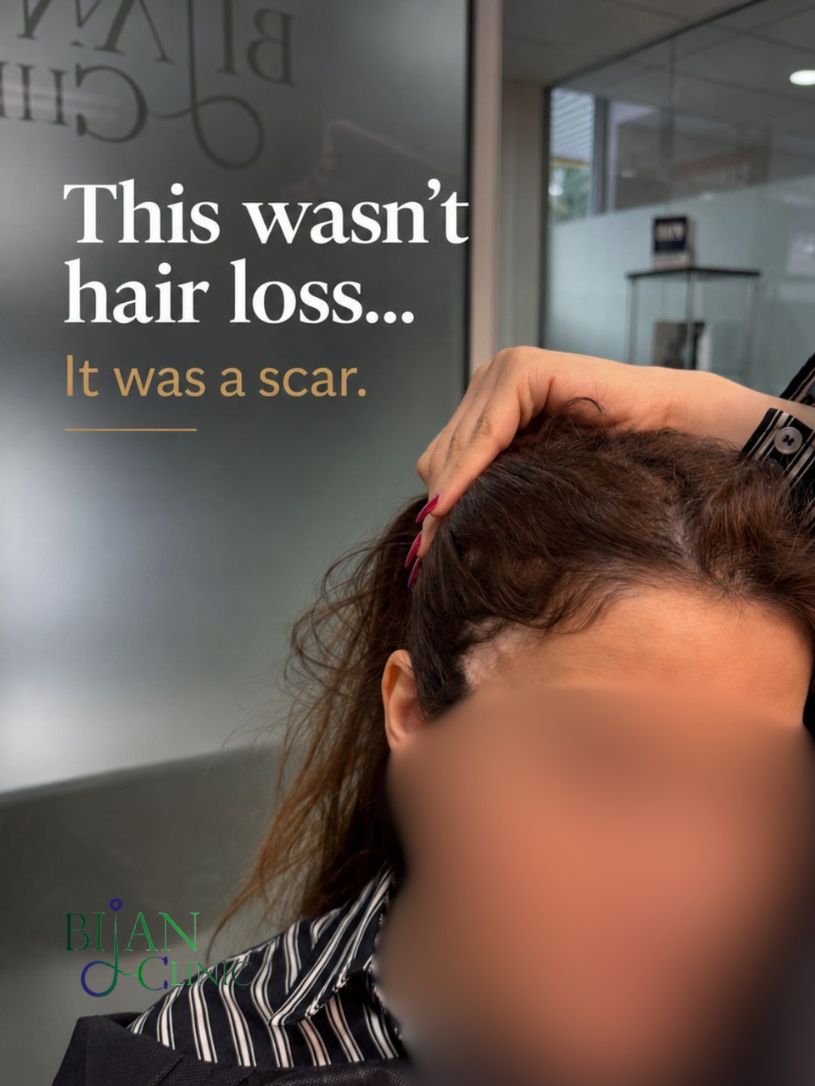
A visible scar along the hairline can be an unexpected and frustrating outcome of a previous eyebrow lift or temporal brow lift procedure. Even when the surgery was performed years ago, the scar may remain noticeable—particularly when the hair is tied back, parted differently or moved away from the temples.
Scar camouflage is one specialised use of hair transplantation. For information about candidacy, graft planning, cost and recovery, read our complete hairline transplant guide.
In selected cases, a hair transplant may help camouflage an eyebrow lift scar by placing healthy follicles within and around the affected area. The procedure does not remove the scar itself. Instead, the aim is to restore hair coverage, soften the visible outline of the scar and reconnect it with the surrounding hairline.
However, scar tissue may not respond in the same way as untreated scalp skin. The quality of the tissue, its circulation and its ability to support transplanted follicles can vary from one patient to another.
This article follows a real patient journey at Bijan Clinic in Sydney. Rather than immediately proceeding with a full procedure, Dr Bijan first performed a small test transplant. Visible hair growth was confirmed approximately six months later, and only then did the patient proceed with a full FUE hair transplant.Current status of this case
- Patient concern: A visible scar interrupting the temple hairline
- Cause: Previous eyebrow lift surgery
- Initial treatment: Small test hair transplant
- Review period: Approximately six months
- Test outcome: Visible hair growth was observed
- Next treatment: Full FUE procedure completed
- Final mature result: Not yet available
The immediate post-operative photographs shown in this article document graft placement on the day of the full procedure. They should not be interpreted as the final result.
This case is one example of female frontal hairline restoration. View more female hairline transplant before-and-after results from Bijan Clinic.
Can an eyebrow lift scar be covered with a hair transplant?
In suitable patients, yes. Healthy hair follicles can sometimes be transplanted into a stable postsurgical scar to make the affected area less noticeable.
However, scar camouflage is not the same as scar removal. The underlying tissue remains present after the procedure. The goal is to grow enough hair through and around the scar to reduce the contrast between the scar and the natural hairline.
The outcome depends on several individual factors, including:
- The condition and maturity of the scar
- The quality of circulation within the tissue
- The width and depth of the affected area
- The availability of suitable donor hair
- The direction and density of the surrounding hair
- The patient’s healing response
- The level of coverage the patient hopes to achieve
For that reason, a consultation should come before any promise about density, graft survival or the number of procedures required.
Case summary: This patient first received a limited test transplant. After hair growth was observed at the six-month review, a full FUE procedure was planned to improve coverage across the wider scar.
What caused this patient’s hairline scar?
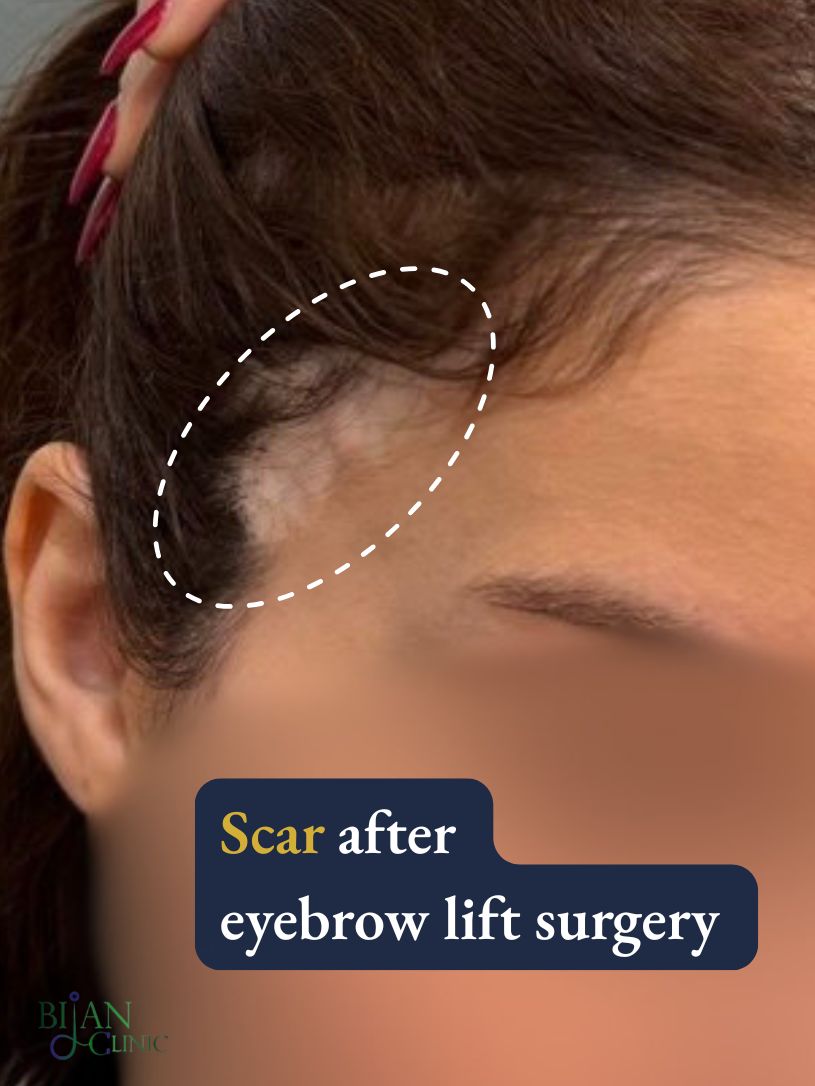
The patient had undergone eyebrow lift surgery several years earlier. After healing, a widened scar remained near the temple and extended into the natural hairline.
The surrounding hair was still present, so this was not a typical case of female pattern hair loss or general hair thinning. The concern was a localised area where the continuity of the hairline had been interrupted by the previous surgical scar.
Because little or no hair was growing through part of the affected area, the lighter scar tissue became more visible when the patient moved her hair away from her face.
The treatment objective was therefore specific:
- Camouflage the visible scar
- Restore continuity along the temple hairline
- Blend transplanted follicles with the existing hair
- Preserve a soft and natural female hairline
- Improve coverage without unnecessarily altering unaffected areas
A mature postsurgical scar interrupted the natural hairline near the temple following a previous eyebrow lift procedure.
Can transplanted hair grow through scar tissue?
Hair follicles can grow in some scars, but successful growth cannot be assumed in every case.
A scar is not simply an area where hair is missing. It is tissue that has changed during the healing process. Its thickness, firmness, flexibility and circulation may differ from those of the surrounding scalp.
These differences can affect how recipient sites are created, how the grafts are positioned and how well the transplanted follicles are supported during early healing.
Importantly, not every scar behaves in the same way.
One scar may be flat, soft and relatively suitable for graft placement. Another may be firm, raised, depressed, irregular or less able to support new follicles. Even scars caused by similar procedures can respond differently.
During an assessment, the clinical team may consider:
Factor Why it matters Scar stability A scar that is still changing may not be ready for transplantation Tissue quality Firm or irregular tissue may make precise graft placement more difficult Circulation Newly transplanted follicles require support during early healing Scar width A wider area may require staged or conservative coverage Hair direction New grafts must blend with the existing temple growth pattern Donor hair Suitable follicles must be available for transplantation Expectations The aim is camouflage rather than removal of the scar A consultation cannot guarantee how every follicle will respond. It can, however, help determine whether transplantation appears reasonable and whether additional caution is needed.
In this case, the uncertainty surrounding the scar tissue was the reason the treatment began with a test transplant rather than a full procedure.
Why did we perform a test transplant first?
A small test transplant was used to answer one practical question:
Could this patient’s scar support healthy hair growth?
Instead of committing a larger number of donor grafts at the beginning, a limited number of follicles were placed into a selected part of the scar.
The medical team could then monitor:
- Whether the grafts established themselves
- Whether visible hair growth developed
- How the treated skin healed
- How the new hair blended with the surrounding area
- Whether a larger procedure appeared reasonable
This staged approach also helped protect the patient’s donor supply. Donor follicles are limited and should be used carefully, particularly when the behaviour of a recipient area is uncertain.
A test transplant is not necessary for every patient with a hairline scar. Some scars can be assessed without a separate test session. In more complex or uncertain cases, however, a small trial may provide useful information before a full FUE hair transplant is planned.
What happened during the following six months?
The patient returned for review approximately six months after the test transplant.
At this appointment, hair growth could be seen within the tested section of the scar. The grafts had produced visible hairs, providing encouraging evidence that the tissue could support transplanted follicles.
Six months was the assessment point selected for this individual case. It should not be interpreted as a universal protocol for every scar or every patient.
The test result did not guarantee that every graft placed during a future procedure would grow. It did, however, give the clinical team more patient-specific information than a visual examination alone could provide.
After reviewing the test area, Dr Bijan and the patient decided to proceed with a complete FUE procedure to treat the wider scar.
Planning the full FUE hair transplant
Once growth in the test area had been assessed, the full procedure was planned around the patient’s existing hairline rather than treating the scar as an isolated patch.
FUE, or Follicular Unit Excision, involves harvesting individual follicular units from a suitable donor area and transferring them to the recipient area.
Although FUE allows follicles to be selected and placed individually, the technique alone does not determine the outcome of a scar hair transplant. Donor selection, recipient-site creation, density, angle and blending are also important.
Patients considering the procedure can learn more about the technique in our guide to FUE hair transplant in Sydney.
Selecting suitable donor follicles
The transplanted hair should blend with the patient’s natural temple hair.
Follicles that are too coarse or visually different from the surrounding hair may make the repaired area appear heavy. Donor selection therefore needs to account for calibre, texture and the visual transition between existing and transplanted hair.
Creating recipient sites within the scar
Scar tissue may feel firmer and respond differently to normal scalp during recipient-site creation.
The sites need to be made carefully so that grafts can be placed at an appropriate depth without unnecessary trauma to the surrounding tissue.
Controlling density
Trying to place the maximum possible number of grafts in one session is not always the best strategy.
The planned density should reflect the condition of the recipient area, the width of the scar and the amount of existing hair available for blending. In selected scar cases, a measured approach may be more appropriate than very dense placement.
Matching the natural hair direction
Hair around the temple usually grows at a low angle and follows a specific direction.
If grafts are placed too upright or against the natural flow, the result may appear noticeable even when the follicles grow successfully.
For this reason, the transplanted hairs needed to follow the direction of the patient’s existing temple hair and gradually reconnect the scarred area with the surrounding hairline.
The same principles are central to natural hairline design, where direction and visual transition can matter as much as graft numbers.
Blending beyond the scar
The procedure should not produce a visible block of transplanted hair.
Grafts may need to be distributed strategically within and around the scar so the transition into the patient’s natural hairline appears gradual.
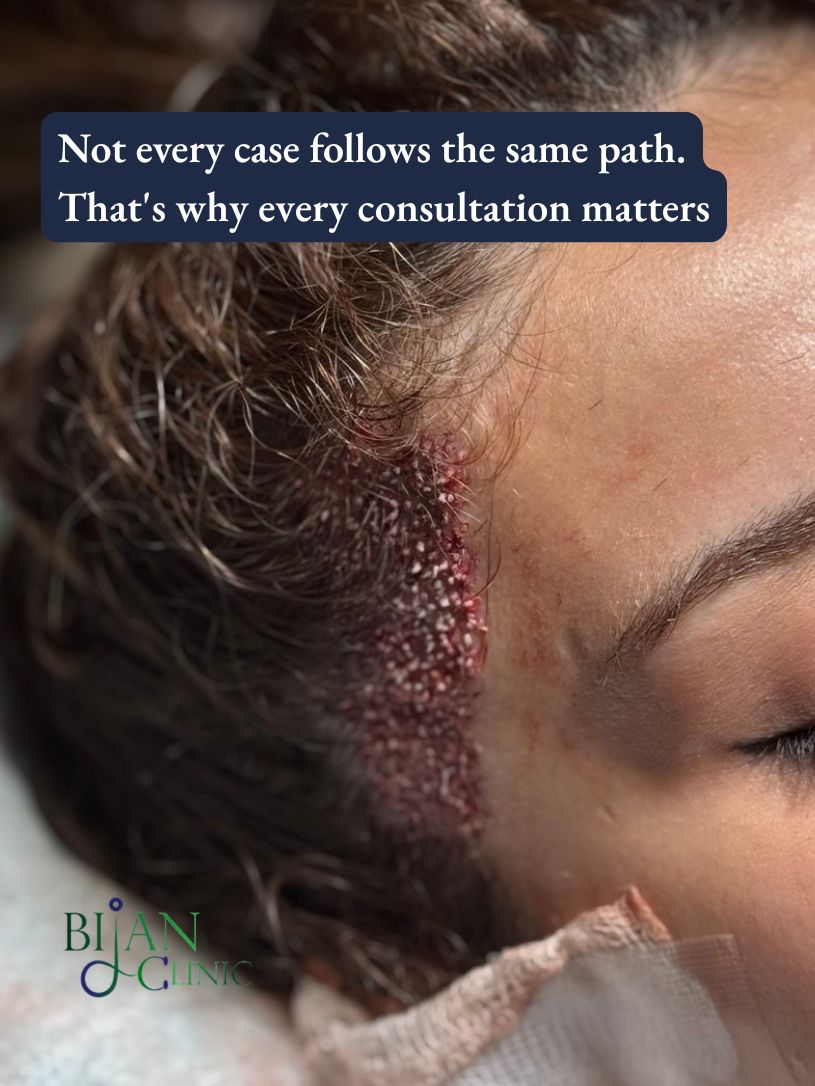
What do the immediate post-operative photographs show?
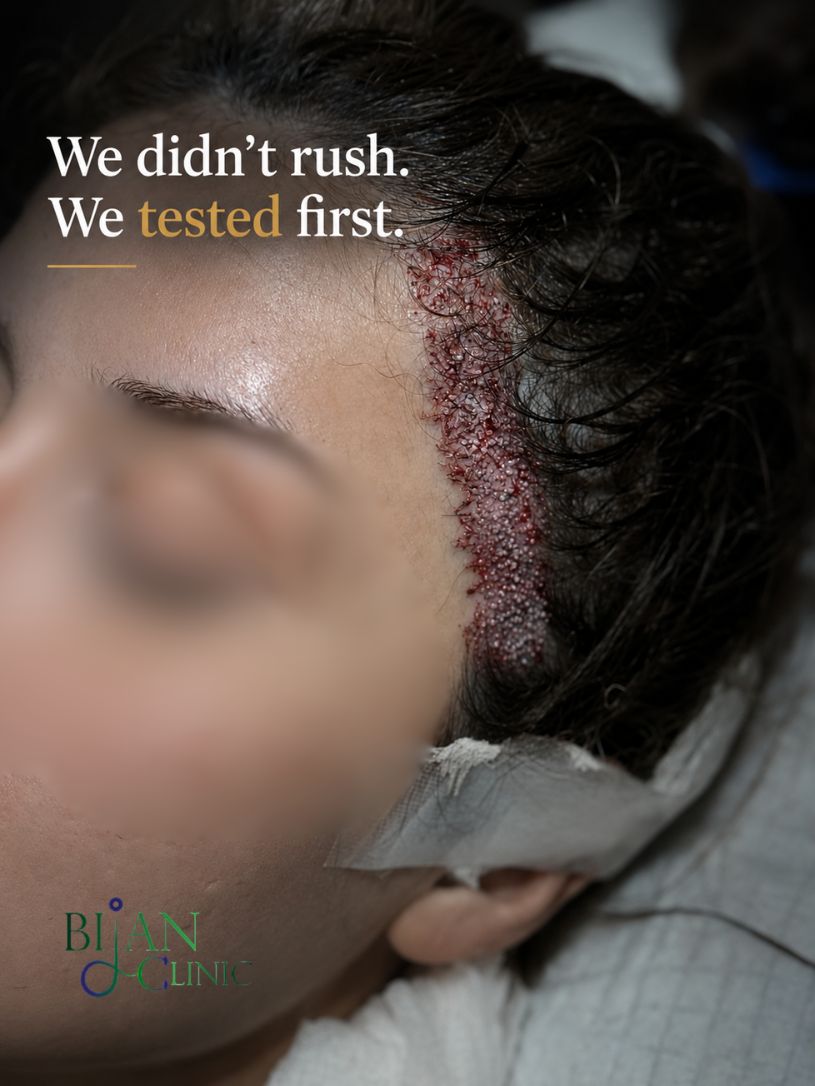
The immediate post-operative photographs were taken shortly after the full FUE procedure.
At this stage, the recipient sites and placement pattern are clearly visible. The treated area may appear red, and small crusts or traces of blood may be present.
These photographs document the procedure. They do not represent the final density, coverage or cosmetic result.
The transplanted follicles still need time to heal and move through their normal growth cycle. The longer-term appearance can only be assessed as new hair begins to grow and mature.
Future follow-up photographs may document:
- Early healing of the recipient area
- Reduction in redness and crusting
- The beginning of visible growth
- Increasing coverage across the scar
- Maturation of the transplanted hair
- Blending with the natural temple hair
- The longer-term visibility of the scar
For more information about the stages that follow surgery, patients can read our hair transplant recovery timeline.
Will the scar disappear completely?
No. A hair transplant does not remove the scar or return the tissue to its original condition.
The objective is camouflage.
As transplanted hair grows, it may:
- Interrupt the visible outline of the scar
- Reduce the contrast between the scar and surrounding hair
- Improve continuity along the temple
- Make the area easier to conceal
- Provide greater styling flexibility
The level of improvement varies. A narrow scar with favourable tissue may respond differently from a wide, firm or irregular scar.
Some patients may achieve satisfactory coverage after one procedure. Others may require a later session if more density is desired and the recipient area is considered suitable for additional grafts.
Who may be suitable for scar hair transplantation?
Hair transplantation may be considered when the scar is mature, stable and located within or near a hair-bearing area.
A potentially suitable patient may have:
- A fully healed postsurgical or traumatic scar
- No active infection or inflammation
- A scar that is no longer changing
- Adequate donor hair
- Healthy surrounding hair for natural blending
- Realistic expectations about camouflage
- An understanding that growth may be less predictable in scar tissue
Further assessment may be required if the scar is raised, painful, inflamed, sensitive or still changing in colour or shape.
The age of the scar alone does not determine suitability. An old scar may still be difficult to treat, while another mature scar may be more favourable.
The decision should be based on the condition of the tissue, the donor area and the patient’s individual treatment goals.
Patients with broader temple thinning or frontal hair loss may require a different assessment from someone seeking treatment for a localised postsurgical scar. More information is available in our guide to female hair transplantation.
Why does experience matter in a scar hair transplant?
Scar transplantation requires more than filling an area where hair is missing.
The surgeon must consider how the scar may behave during recipient-site creation, graft placement, healing and hair growth.
The treatment plan may need to balance:
- Scar quality
- Graft spacing
- Recipient-site depth
- Hair angle and direction
- Donor preservation
- Existing hairline design
- Expected growth
- The possibility of staged treatment
In this case, the treatment was based on observation rather than assumption.
A small area was treated first. The response was reviewed after approximately six months. The full FUE procedure was performed only after visible growth had been confirmed.
That decision-making process was an important part of the treatment.
Dr Bijan’s clinical note
The following wording should only be published after Dr Bijan has reviewed and approved it:
“Because scar tissue may respond differently from normal scalp skin, we chose to test a small section first. Visible growth at the six-month review gave us patient-specific information before planning the full procedure.”
The treatment timeline
Stage 1: Clinical assessment
The hairline scar, surrounding hair and donor area were evaluated.
Stage 2: Small test transplant
A limited group of follicles was placed into part of the scar.
Stage 3: Six-month review
Visible hair growth was identified within the test area.
Stage 4: Full FUE procedure
A broader treatment was planned to improve coverage across the scar and reconnect it with the natural hairline.
Stage 5: Ongoing follow-up
The recipient area will be reviewed as healing, growth and maturation progress.
This timeline is specific to this patient. Another person with a similar-looking scar may receive a different recommendation.
Frequently asked questions
Can hair be transplanted directly into scar tissue?
Hair follicles can be placed into selected scar tissue, but growth is not equally predictable in every scar. The condition, stability and circulation of the recipient area must be assessed before treatment is recommended.
Does a hair transplant remove an eyebrow lift scar?
No. The scar remains beneath the transplanted hair. The purpose of the procedure is to reduce its visibility by growing hair through and around the affected area.
Is a test transplant always required?
No. A test transplant is an individual clinical decision. It may be useful when the quality of the scar is uncertain or when the surgeon wants to assess growth before using more donor grafts.
Why did this patient wait six months after the test?
Six months was the review interval used in this patient’s treatment plan. At that stage, visible growth provided useful information for deciding whether to continue with a larger procedure.
How long after an eyebrow lift can a hair transplant be performed?
There is no single waiting period that is correct for everyone. The previous surgical site should be fully healed and the scar should be stable. Timing should be based on an assessment of the scar rather than the calendar alone.
Is FUE suitable for an eyebrow lift scar?
FUE may be suitable because individual follicles can be selected and placed into specific areas of the scar. Suitability still depends on the recipient tissue, donor supply and the surgeon’s treatment plan.
Can an old eyebrow lift scar still be treated?
Possibly. The age of the scar is only one consideration. Its texture, colour, firmness, width and clinical stability are also important.
Will one FUE session provide complete coverage?
It may provide meaningful camouflage, but complete coverage cannot be promised. Some patients may later consider another session after the first result has matured.
Every scar requires its own plan
This patient’s treatment did not begin with a full procedure.
It began with an assessment, followed by a small test transplant and a six-month observation period. After growth was confirmed in the tested section, a complete FUE hair transplant was performed to improve coverage along the scarred hairline.
The next stage is to monitor healing and document the patient’s growth over time.
A visible scar following eyebrow lift surgery can be difficult to conceal, but selected patients may have options. The right starting point is not an assumption about what will work—it is a personalised assessment of the scar, donor hair and treatment goals.